
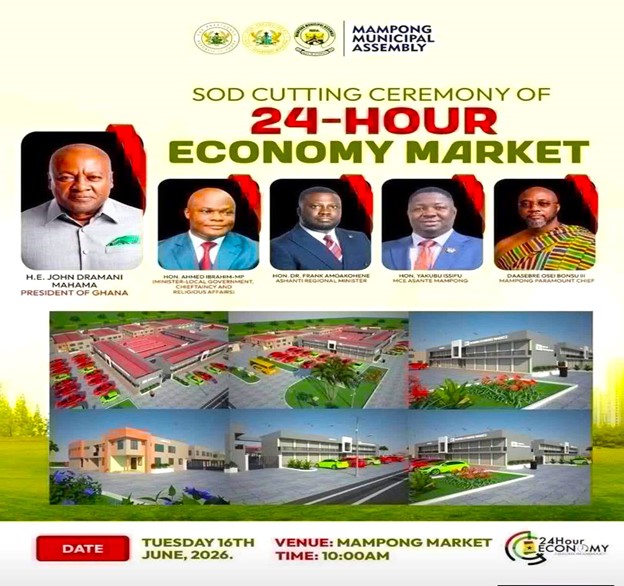
The sod cutting ceremony held on Tuesday, 16th June 2026 at Mampong Market marked the official commencement of the 24-Hour Economy Model Market a flagship intervention under government’s economic transformation agenda. The project is designed to reposition local commerce by providing modern infrastructure that supports extended trading hours, improved storage, enhanced sanitation and robust security systems.
Site assessment was conducted by project consultants on Friday, 5th June 2026 to verify suitability and alignment with technical requirements. Preliminary works were completed prior to the ceremony paving the way for construction to begin. The facility was envisioned as a commercial hub that integrated drainage, lighting and waste management systems to facilitate round-the-clock trading, reduce congestion and minimize post-harvest losses for farmers and traders.
On behalf of the traditional council of Asante Mampong, Nana Omono Asamoah Agyekumhene II who represented the paramount chief Daasebre Osei Bonsu III expressed gratitude to the Government, the Municipal Assembly and all partners whose commitment transformed a long-held vision into action. Markets have always served as the foundation of local economies and social cohesion. This modern multipurpose facility is designed to move beyond the traditional market model. With constant utilities, security, cold storage, financial services, health clinics and childcare. It is structured to support continuous economic activity across three eight-hour shifts. The core objectives were clear. Youth employment would expand through new roles in logistics, security, sanitation and administration. Women traders and entrepreneurs would gain flexible access to trade and finance. Farmers would secure reliable outlets for produce, reducing post-harvest losses and increasing income. This transformation could not be achieved by government alone. Its success depended on collective responsibility. The private sector is expected to invest in off-peak logistics and services. Stakeholders were urged to ensure transparency, safety and accountability throughout construction and operation. Traders and citizens were called to embrace the shift with discipline and unity.
In conclusion, the hope was that this market would function as a fully integrated commercial hub where no hour will be wasted and no opportunity will be lost. May it become a lasting legacy of growth, productivity and shared prosperity for Mampong as said by the traditional council.

Nana Omono Asamoah Agyekumhene II delivering his acceptance speech
After the sub chief’s acceptance speech, students of St. Monica’s Senior High School presented a captivating cultural display centered on the 24-Hour Economy Market vision. Through choreographed dance, live drumming and thought-provoking drama. They illustrated a market that never closes its gates to progress. The performance highlighted three-shift work creating jobs for youth, women trading with dignity, access to micro-finance and farmers delivering fresh produce at night to lit secure stalls. Costumes blended traditional patterns with modern market symbols while their lyrics emphasized discipline, unity and round-the-clock productivity. The display moved beyond entertainment translating policy into imagery the community could feel. It was a proud moment that connected tradition with aspiration and reminded everyone that the market’s success would be built on collective effort, energy and shared purpose.

Students of St. Monica’s Senior High School presenting a captivating cultural display on the 24-Hour Economy Market
The initiative aligned with the Municipality’s development priorities of stimulating economic growth, improving internally generated revenue and creating decent work opportunities for youth and women. Construction is expected to proceed with strict adherence to quality standards, transparency and schedule compliance. The market is projected to strengthen Mampong’s position as a trade center in the Ashanti Region, attract new businesses and deliver long-term socio-economic benefits to current and future generations through sustainable urban development.
In the keynote address, the Municipal Chief Executive Hon. Yakubu Issifu welcomed the occasion as a memorable milestone marking the sod-cutting ceremony for the commencement of the long-awaited Mampong Municipal 24-Hour Economy Model Market. The Assembly recognized the event as a significant step in the Municipality’s development, bringing together stakeholders committed to the growth and transformation of Mampong.

The Hon. MCE felt very excited and lucky to have such a remarkable project commencing in his tenure of office. The project commencing during the tenure was regarded as a remarkable privilege. Most districts faced challenges with site selection that often delayed construction but the choice of project site in Mampong was resolved without difficulty through the support of the traditional leadership. Sincere gratitude was extended to the paramount chief of Asante Mampong, Daasebre Osei Bonsu III and the Queen mother of Mampong Municipality, Nana Agyakoma Difie II for the unwavering support that made the day possible.
Local markets are recognized as platforms where businesses thrived acting as economic engines and social hubs. They empower traders, kept money circulating locally and provide safe vibrant spaces that strengthened cohesion between buyers and sellers.
The Hon. MCE stated categorically that in many developed economies, markets operate 24/7 through three eight-hour shifts to enable continuous trade and service delivery. In line with the President of the Republic of Ghana, John Dramani Mahama’s vision to modernize traditional markets, the initiative was designed to allow traders with farm produce and other wares to operate around the clock and stimulate economic activities. This was a campaign promise and commitment to fulfilling it remained firm.

The Government’s dedication to equitable development through the implementation of 24-Hour Economy Markets aimed to deepen local economic development and decentralization. The concept was not about extending working hours for tired traders but about a well-structured, multi-shift system with three distinct eight-hour shifts supported by a comprehensive state-led ecosystem.
The policy decision backed by the Ministry of Local Government, Chieftaincy and Religious Affairs paves the way for a modern model market that move beyond the traditional definition of a market space. It is designed as a multipurpose logistics and community hub. Constant utilities such as water and lighting are integrated alongside robust security infrastructure. Financial and storage services are also included with dedicated banking spaces for women, commercial supermarkets, and advanced cold-storage warehouses to eliminate post-harvest losses. Social amenities were also prioritized, with on-site healthcare clinics and crèches or kindergartens to ensure children were safely cared for while parents worked their shifts.

A pictorial view of the Presiding Member, Hon. Daniel Oduro observing proceedings.
This memorable sod-cutting ceremony marked the commencement of construction for a modern multipurpose market for Mampong Municipality. There was confidence that once completed, the 24-Hour Economy Market would function as a fully integrated commercial hub designed to support continuous economic activity. The facilities planned for the market included a fire station, a clinic, two cold stores, ninety-seven lockable shops, ten warehouses, male and female washroom facilities, a police station, a restaurant, guest rooms, a crèche, a banking hall, a supermarket, over one hundred sheds and stalls, a livestock bay, a refuse collection point, and a food court. The project consultant was scheduled to provide further details on the scope and specifications for information.

The Municipal Coordinating Director, Madam Esther Abaching watched as proceedings were going on.
Hon. Yakubu Issifu outlined some of the core benefits of the market which were anchored on jobs, productivity and growth. Job creation for the youth was central to the design. Moving from a single-shift to a three-shift system multiplied employment opportunities instantly. Sustainable roles were created for loaders, porters, drivers, security personnel, sanitation workers and administrative managers. Women entrepreneurs and local traders who formed the backbone of commerce were empowered through continuous market access. The 24-hour operation gives them flexibility to scale businesses and access micro-finance directly at their trading points. With agriculture, the market provides a secure outlet. Farmers no longer have to watch produce rot in remote villages. Goods can be transported to distribution hubs overnight with a well-lit active market ready to monetize their harvest instantly.
This transformation could not be achieved by government alone. Its ultimate success depended on collective national commitment. The private sector was expected to invest in off-peak logistics. Traditional leaders, opinion leaders, and all stakeholders were required to remain active on the ground to ensure transparency, safety, and contractor accountability. Most importantly, traders and citizens were called to embrace the shift with enthusiasm.
In his concluding remarks, the Hon MCE stated that the vision is for a model where no hour will be wasted, no youth remained idle and no market gate will ever be closed to prosperity. The call was to build a round-the-clock economy together.
The consultant for the 24-Hour Economy Market was subsequently invited to provide a detailed exposition on the project. With clarity and precision, the consultant outlined the design philosophy, infrastructure layout and operational framework of the multipurpose facility. Emphasis was placed on the integration of a fire station, clinic, cold stores, banking hall and childcare center to ensure safety, health and convenience for all users. The operational plan for three-shift activity was explained, showing how continuous power, security and sanitation would sustain round-the-clock commerce. Specifics on shop allocation, warehouse capacity and logistics flow were also presented. The presentation underscored that the market was engineered not only as a trading space but as a structured ecosystem to drive jobs, productivity and sustained economic growth for Mampong Municipality.
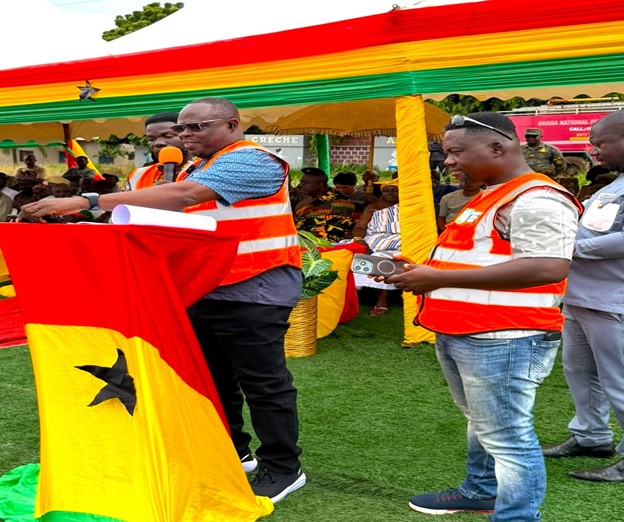
Consultant, Dr. Asamoah providing a detailed explanation on the 24hr economy market.
The consultant formally presented the 24-hour economy market contract document to the Honourable Municipal Chief Executive. The report outlines operational strategies, revenue projections, security measures and stakeholder engagement plans. The MCE received it commending the thorough research and pledged to review recommendations for boosting local trade, job creation, and day-and-night economic activity.

The consultant presenting the 24-hour economy market contract document to the Honourable Municipal Chief Executive
The Honourable Municipal Chief Executive formally handed over the contract document to the contractor in a brief ceremony at the market square. The document details project scope, deliverables, timelines, quality standards, payment terms and compliance requirements under Ghana’s procurement laws. The MCE emphasized accountability, timely execution and job creation for local youth. The contractor acknowledged receipt, pledged adherence to specifications, safety protocols and community engagement. Both parties agreed on periodic site inspections and progress reporting to ensure transparency, value for money and successful delivery of the 24-hour economy market project for the municipality.

The Honourable Municipal Chief Executive formally handing over the contract document to the contractor
In a ceremony marked by dignity, purpose and cultural respect, the Municipal Chief Executive supported by a distinguished gathering of invited dignitaries, community leaders and witnesses formally performed the symbolic sod-cutting to approve the official commencement of the briefed project. This time-honored tradition was more than a ceremonial act. It served as the formal authorization for construction to begin while also invoking communal blessings for progress, safety and successful delivery. The cutting of the sod represented the community’s collective endorsement and optimism that the project will bring lasting development and opportunity. Beyond approval, the act carried significant legal and procedural meaning.

The Honourable Municipal Chief Executive cutting sod
With the spade, the MCE symbolically transferred custody of the designated land from the municipal authority to the contractor. This handover signifies that the contractor now has rightful access to the site to begin work but strictly under the technical supervision and guidance of the appointed project consultant. The consultant will oversee compliance with approved designs, quality standards, safety regulations and the agreed project timeline. The event thus marked a pivotal transition from planning and paperwork to tangible action on the ground reflecting shared commitment by government, stakeholders and the people to see the vision become reality.
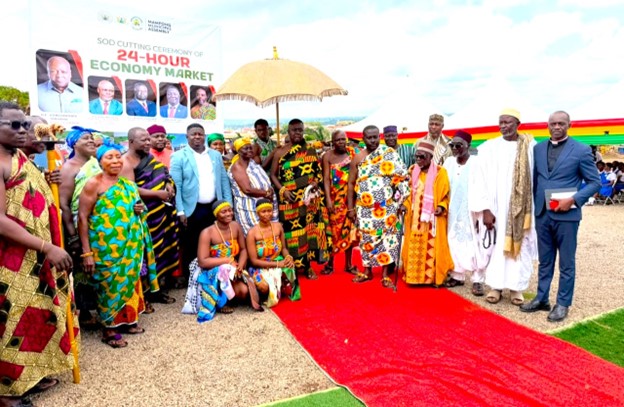
Group Picture with Hon. MCE and Other Attendees
In attendance were Nananom, the Hon. Presiding Member, the Municipal Co-ordinating Director, the Heads of Security Services, the Constituency Leadership of the NDC, Hon. Assembly Members, Heads of Department and Units, distinguished invited guests, and friends from the media whose collective presence reflected strong institutional support, cross-sectoral collaboration and shared commitment to the success of the program. Their participation underscored the importance of unity between traditional authority, political leadership, security agencies, local government, technical staff and the media in advancing development ensuring accountability and promoting inclusive decision-making for the benefit of the entire community.
–Ferdinand Alifo, MMA MIS